Einstellungen
 Schnelle Lieferung
 Kostenlose Lieferung
 Incoterms
 Zahlungsmethoden


 Marketplace-Produkt

Low-Cost, Power Efficient EMG Prosthetic Hand (Part 3)
2026-06-08 | By Antonio Velasco
Creating a prosthetic arm is challenging. Creating an accurate prosthetic arm, even more so. However, making a prosthetic that is accurate, low-cost, and easy to calibrate is another world altogether. Yet, for my UC Irvine Senior Capstone project team, it was a challenge we took head-on. If you've been following along (Part 1, Part 2), you know the journey so far: a $300 budget, an STM32 microcontroller, a dry EMG electrode, and a lot of ambition. In my first blog, I talked about the plan and the overall roadmap. In my most recent blog, I talked about the technical plans and the road bumps we encountered. With all that out of the way, let’s talk about the final implementation and the results.
Hardware Issues & Solutions
The biggest headache we encountered early on was signal quality. Most of our initial roadmap and tests were hampered by the fact that the signals we were getting were basically all noise. This wasn’t something we could calibrate away despite better placement and software filtering, and it led us to look into our electrodes more deeply. We ended up figuring out that the wet/gel electrode was simply not effective.
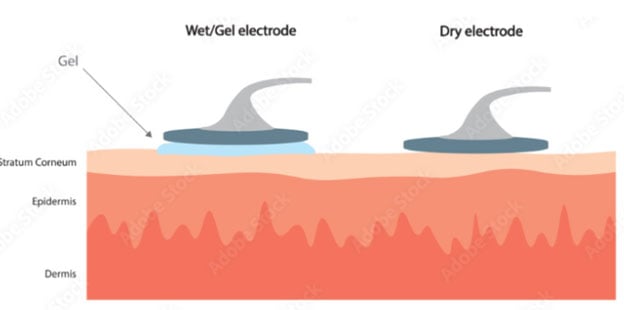
You can see in the figure that a wet electrode requires a gel or intermediary to the wrist for conduction and signal detection. The gel allows us to increase sensitivity and get a better signal, but in our case, it just gave us more noise. So to try to mitigate this, we opted for a dry electrode placed directly on the wrist. We saw an immediate difference with the signals becoming regular, repeatable, and interpretable. Best of all, this means that the sensor can easily be taken on and off without much issue. We were able to increase both signal integrity and sensor usability with one switch!
Another open item that gave us a ton of grief was our servos. Originally, we were planning on using positional servos, which just take a PWM signal to hold a certain angle. Unfortunately, when the shipment of parts arrived, we found that we had mistakenly ordered continuous-rotation servos (which can keep turning and turning). I was too quick on the jump when ordering on DigiKey’s website. Good lesson for next time! But in either case, one of my teammates went above and beyond to challenge himself with these servos by implementing a PID feedback loop using the servo’s position feedback (they have embedded encoders) to estimate and hold angles.
He was able to get the servo angle to within -/+ 5 degrees, which was more than enough to produce distinct hand positions.
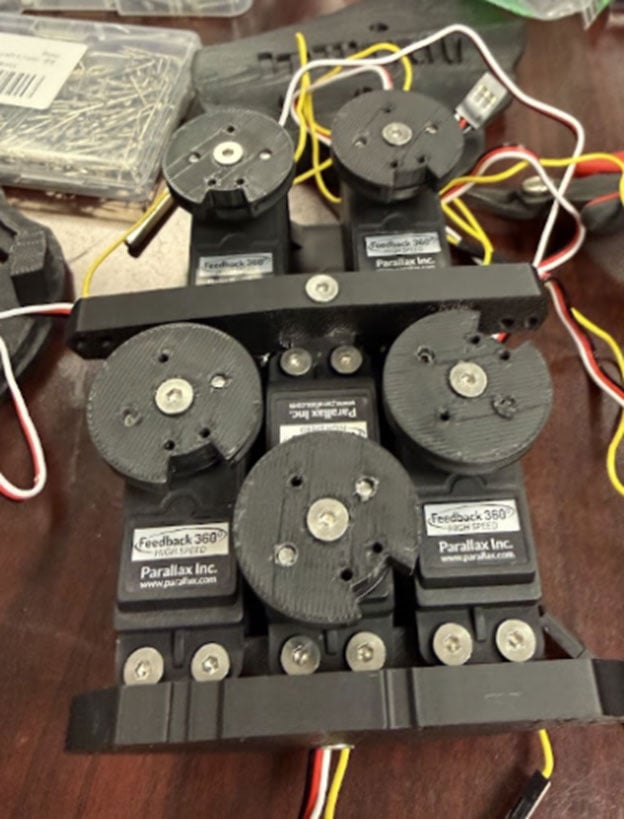
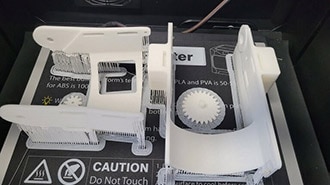
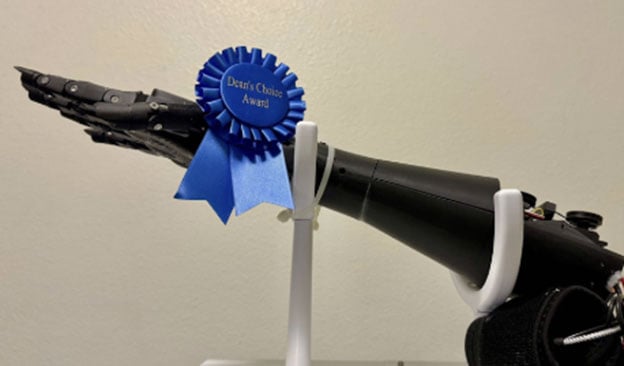
With everything being set, we looked at physical fabrication. The entire chassis (hand, palm, and finger segments) was 3D printed in PLA on a standard printer. Fingers are connected internally with braided strings routed over pulley wheels mounted on the servos. Tension springs inside each finger provide the restoring force that opens the hand when the servos release. The whole assembly is held together with screws and adhesive.
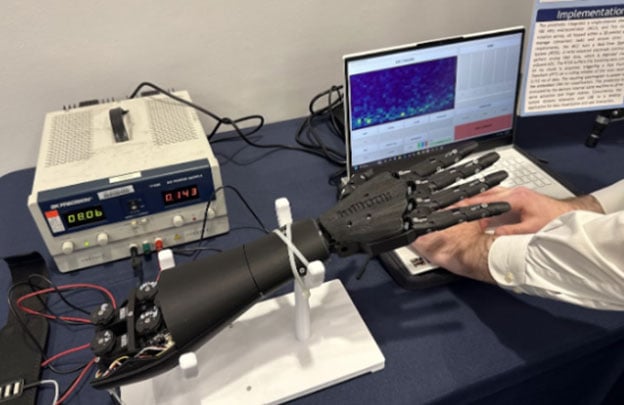
The dry electrode is meant to be secured with the elastic band, keeping it flush and tight to reduce noise. The final build houses all five finger servos plus the STM32 board and signal processing board inside the palm cavity, with USB-C used for both power and communication with the desktop application. We also used an external power supply for demo purposes, but a battery can also be implemented into the actual assembly.
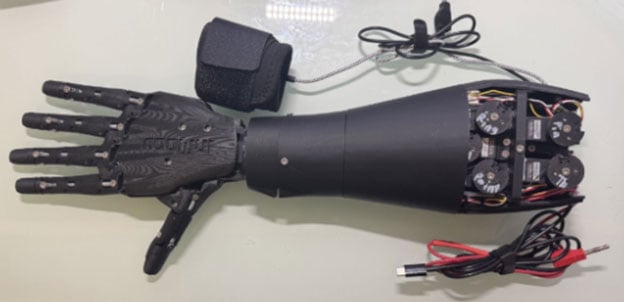
Software Wrap-Up
Software was a different beast here. Thankfully, one of my team members was extremely well-versed in it and got it going, featuring a convolutional neural network (CNN).
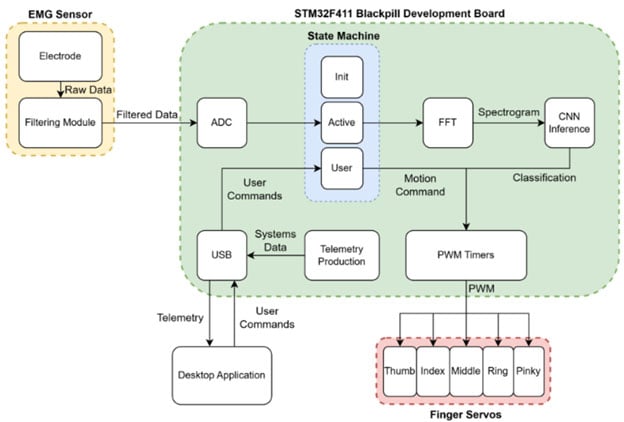
He also got a desktop application going for us, featuring the current state of each finger and the spectrogram showing the classified functions. Also, there’s a feature to individually move each finger and make custom gestures!
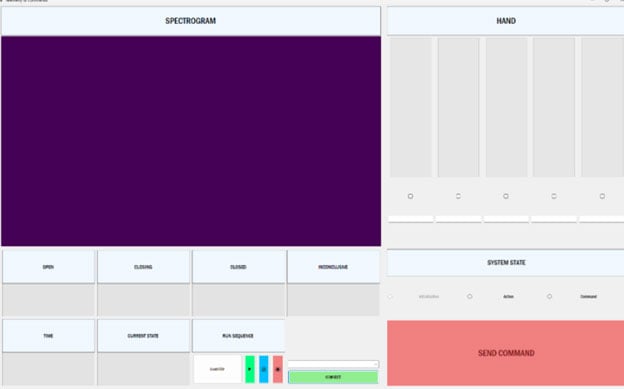
We ended up with three main gestures:
- Open Rest - hand relaxed and open
- Close Rest - hand partially closed, at rest
- Close Hand - active fist closure
We initially aimed for a broader gesture vocabulary, but expanding beyond three gestures pushed classification accuracy below our 90% target. The current electrode configuration and dataset size simply couldn't support more without ambiguity. Three gestures turned out to be the sweet spot between functional utility and reliable performance. We could likely get better resolution with more electrodes, but with a limited budget and time, one sensor proved to be sufficient for a proof of concept.
To give the CNN enough diversity to generalize, we collected 75–80 training spectrograms from multiple users. This enables us to just throw the wristband onto anybody, and it would work as it recognizes what a signal typically looks like from a human. Granted, there are differences between people, but the network was trained over 75 epochs, with both training and validation accuracy stabilizing at around 90%. The loss curves showed a healthy convergence, suggesting the model was learning genuine signal patterns rather than memorizing individual samples.
Each gesture produces a distinct frequency distribution in the spectrogram, which is exactly what a CNN is well-suited to exploit. The spatial patterns in frequency vs. time are analogous to image features, and the convolutional layers pick them up naturally.
Next Steps, Results, & Final Product
After integrating everything, the system was able to perform with end-to-end latency at 39ms, well inside the 500ms target and fast enough to produce motion that feels instant. We were also able to achieve over a 90% recognition accuracy across all of the gestures during live operation. An internal state machine further stabilizes the output by filtering out transient or anomalous predictions, preventing the hand from twitching in response to noise spikes.
Best of all, our total manufacturing cost gets to $260, below the $300 threshold we set.
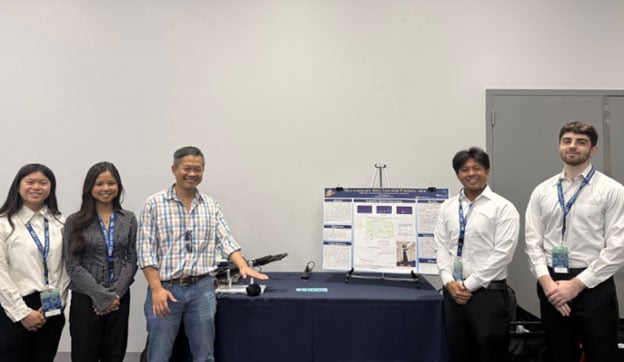
We demo’d the arm and the software at UCI’s Annual Design Review, where engineering senior capstone and project teams are presented “Science Fair” style. Companies, professors, and researchers come to view the work that engineering students have done over the past year, and the Dean awards the top few! We were fortunate enough to be one of those few!
Notably, though, there are steps to be taken. The device works, but it’s not ready to be used as a prosthetic just yet. It’s not sleek enough to be attached to an arm, and the finger cable tension causes a slight bend of the PLA frame, tanking the long-term reliability. This would require a redesign or new material and an overhaul of the design. Additionally, the three-gesture move-set limits the real-world utility, which we could potentially solve with more sensors. But again, they aren’t failures, but rather steps to be taken.
Takeaways
Building a functional, CNN-driven prosthetic hand for $260 is possible. The combination of a dry electrode, FFT-based spectrograms, and an embedded convolutional neural network gives you a surprisingly capable gesture recognition pipeline on modest hardware. There are steps to take and steps to improve, and dealing with the hardware was far from simple, but it’s possible!
If you're thinking about building something similar, start with your sensor. Everything downstream depends on signal quality. And don't underestimate how much work goes into turning a classification output into reliable, smooth mechanical motion.
It's been a genuinely difficult, genuinely rewarding project, and exactly what a senior capstone should be.
Our final report was published by UC Irvine as a result of winning the Dean’s Choice and can be found here: https://escholarship.org/uc/item/4z80v04h