Einstellungen
 Schnelle Lieferung
 Kostenlose Lieferung
 Incoterms
 Zahlungsmethoden


 Marketplace-Produkt


Use AOCs to Extend USB-C and HDMI Over Long Distances in Rugged Environments
When I got my first USB-C laptop, it was like magic. Out went the rat’s nest of single-purpose cables, all replaced by a single connection.
A similar transformation is underway across defense, industrial, and other rugged computing systems. Application-specific connectors are being replaced by commercial off-the-shelf (COTS) technologies, such as USB-C and HDMI cables, whose plug-and-play convenience significantly improves usability.
Take the mobile command center as an example. These centers pack in as many mission-critical computers, displays, and other equipment as possible, all of which require connections. Traditional cables are cumbersome to install, making them a poor fit for a system that must be set up, struck down, and rewired in the field.
USB-C offers a compelling alternative for connecting digital devices. In addition to replacing multiple cables, the interface automatically negotiates the data, display, and power configurations. HDMI brings similar benefits. As the default interface for most displays, it supports discovery mechanisms that enable displays to light up as soon as they are connected.
Challenges of adapting USB-C and HDMI to field environments
While these benefits are undeniable, deploying USB-C and HDMI in field environments can be challenging. One of the biggest issues is cable length. Unlike the short cables at my now-tidy desktop, field applications often require runs that far exceed the reach of standard copper cables.
One way around this problem is to add repeaters or powered extenders to a long run. Alternatively, high-speed signals can be run over fiber optics. However, both options involve extra equipment with their own power supplies, undermining the simplicity that makes USB-C and HDMI so attractive.
Ruggedized USB-C and HDMI fiber optic cables integrate active electronics
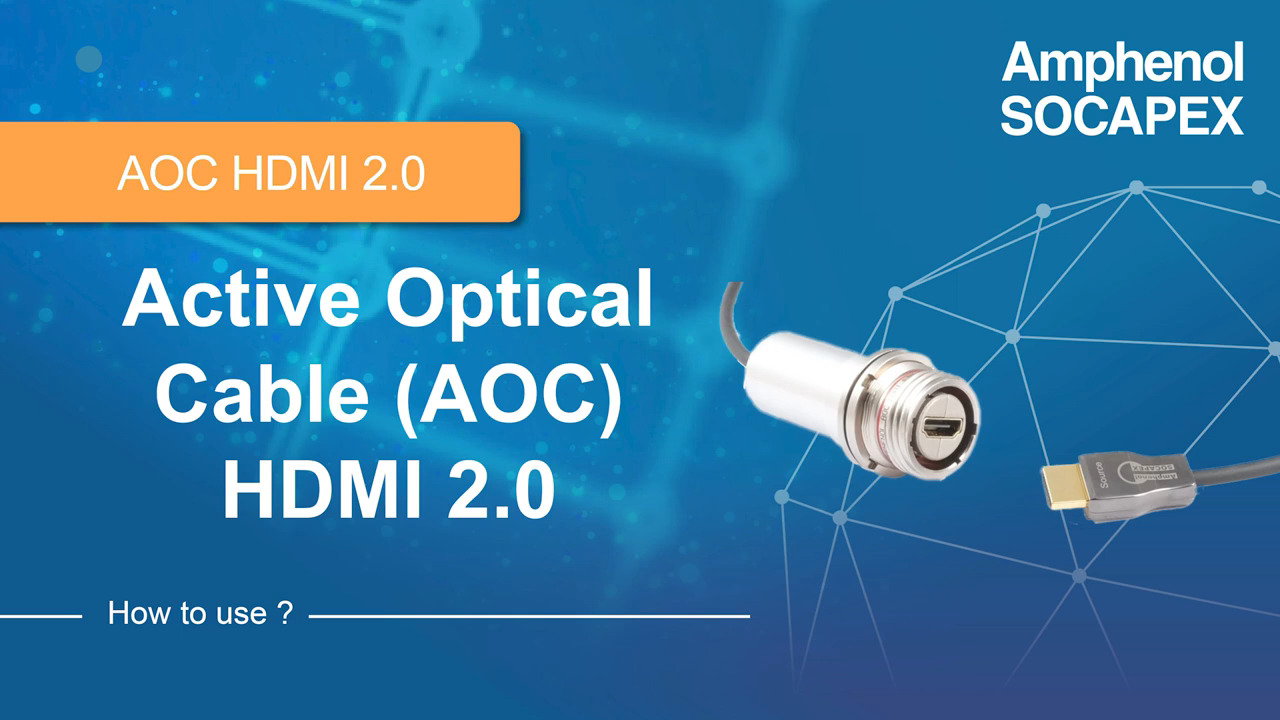
To address this quandary, Amphenol has created ruggedized active optical cable (AOC) versions of its USB-C and HDMI offerings. These cables feature integrated active electronics in a hybrid copper/fiber architecture. They draw power directly from the equipment they connect to, so there is no external power supply; the assembly behaves like a conventional plug-and-play cable, just with a longer reach.
Both families share the same basic design: one end of the cable is a standard COTS connector, while the other is a ruggedized connector. The rugged end uses a MIL-DTL-38999 Series III-style shell with threaded coupling, is rated IP68 when mated, and resists shock, vibration, and traction. It comes in a choice of platings, including olive drab cadmium, nickel, and black zinc nickel.
Supplied as fully terminated assemblies, the cables require no tooling to connect. Both families are supported by an ecosystem of ruggedized panel-mount receptacles and accessories, including protective covers.
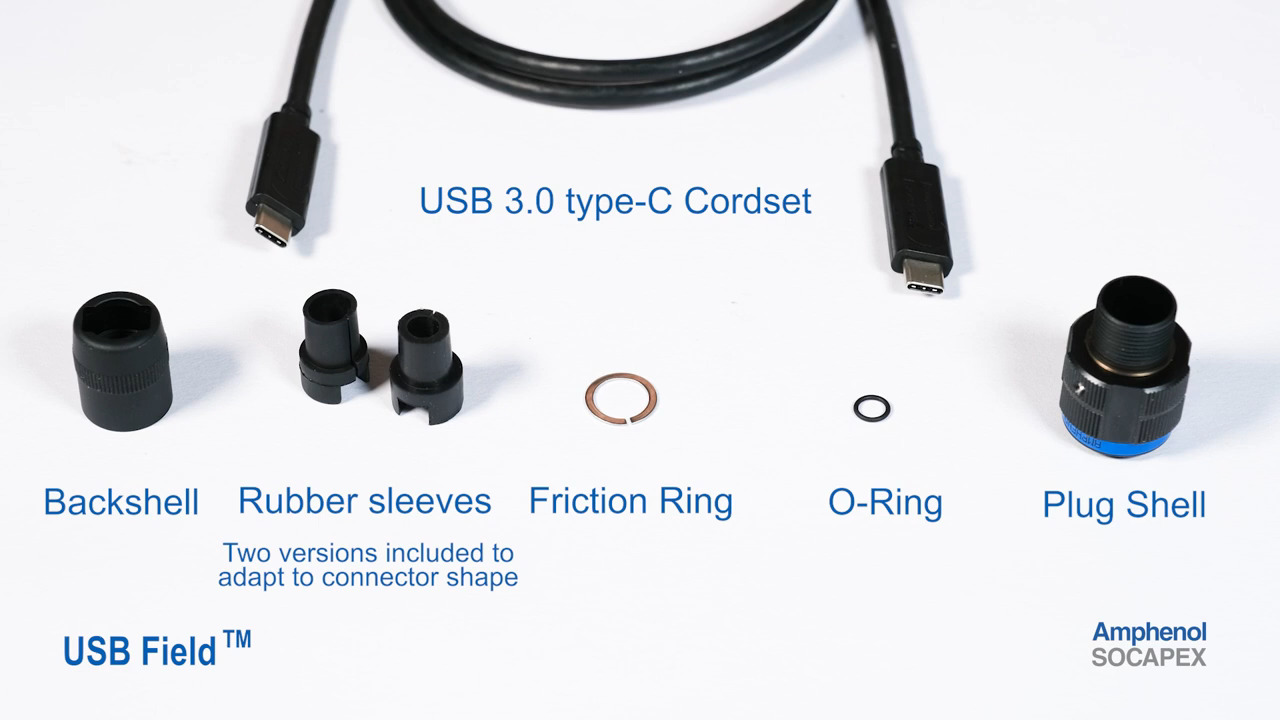
USB-C AOCs deliver data, video, and power
The USB-C family comes in lengths up to 15 meters (m), compared to approximately 1 m for passive copper USB-C cables operating at full performance. The cables support USB Power Delivery of 60 watts at 5 and 10 m, stepping down to 40 watts at 15 m.
USB 3.2 Gen 2 support enables data transfer speeds up to 10 gigabits per second (Gbits/s). DisplayPort Alternate Mode video supports up to 8K at 60 hertz (Hz) or 4K at 120 Hz.
A typical example is the AOCUSB3CFTV6N050 (Figure 1), a 5 m cable with a standard USB-C plug on one end and a USB3CFT plug on the other. The connectors are nickel-plated, and the cable delivers 60 watts. Like all members of the family, it has a ruggedized end with shell size 11 and is rated for 500 mating cycles.
 Figure 1: The AOCUSB3CFTV6N050 5 m ruggedized AOC USB-C cable uses nickel-plated connectors and delivers 60 watts. (Image source: Amphenol)
The AOCUSB3CFTV6N050’s USB3CFT plug mates with the USB3CFTV22N panel-mount receptacle (Figure 2). Also finished in nickel, this receptacle installs in a panel or bulkhead and provides the fixed half of the connection.
 Figure 2: The USB3CFTV22N receptacle mounts to a panel and accepts the AOCUSB3CFTV6N050 cable’s rugged USB3CFT plug. (Image source: Amphenol)
HDMI AOCs push high-def video over long distances
The ruggedized AOC HDMI cables reach 100 m, far beyond the roughly 5 m practical limit of copper HDMI. They support HDMI 2.0 at 18 Gbits/s and 4K video at 60 Hz.
The HDMI cables are offered in a choice of rugged end styles, all in shell size 17: a plug, a square-flange receptacle, or a jam-nut receptacle. The square-flange and jam-nut versions are panel-mount styles, intended for permanent installation in a panel or bulkhead, with a mating plug connecting to them.
A typical example is the OAHDMIFTV6AG0100 (Figure 3). This 10 m cable uses the plug-end style and cadmium plating. It features a tri-start threaded coupling with an anti-decoupling device that keeps the cable mated under shock and vibration.
 Figure 3: The OAHDMIFTV6AG0100 10 m ruggedized AOC HDMI cable features a tri-start threaded coupling with an anti-decoupling device. (Image source: Amphenol)
The OAHDMIFTV6AG0100’s plug mates with the HDMIFTV2AGF459 square-flange receptacle (Figure 4). Finished in cadmium, this panel-mount component bolts to a bulkhead via its square flange.
 Figure 4: The HDMIFTV2AGF459 square-flange receptacle is designed for permanent panel mounting. (Image source: Amphenol)
Conclusion
The universality of USB-C and HDMI was already simplifying the design and usability of field systems. Now, with Amphenol’s ruggedized USB-C and HDMI AOC cables, the convenience of these COTS technologies extends to much greater distances. Paired with their matching receptacles and accessories, these cables address connectivity challenges in defense, industrial, and other rugged computing applications.
Über den Autor

Kenton Williston schloss sein Studium der Elektrotechnik im Jahr 2000 mit einem B.S. ab und begann seine Karriere als Benchmark-Analyst für Prozessoren. Seitdem arbeitete er als Redakteur bei der EE Times Group und half bei der Einführung und Leitung mehrerer Publikationen und Konferenzen für die Elektronikindustrie.

Have questions or comments? Continue the conversation on TechForum, Digi-Key's online community and technical resource.
Visit TechForumWeitere Beiträge dieses Autors