Einstellungen
 Schnelle Lieferung
 Kostenlose Lieferung
 Incoterms
 Zahlungsmethoden


 Marketplace-Produkt

IDC Connectors Reduce Wiring Time, Material, and Risk in Industrial Environments
Zur Verfügung gestellt von Nordamerikanische Fachredakteure von DigiKey
2026-05-07
Although today’s data is increasingly mobile, behind the scenes there is more wiring than ever. Anyone installing new equipment or expanding existing bandwidth faces three fundamental concerns: minimizing the time needed for the installation, ensuring reliable connections, and translating wiring diagrams into functional field installations.
Application-specific considerations like limited space, high connection density, branched networking, or power transmission further complicate these installations. Designers and installers need trusted options for wire termination that are time-saving, durable, and field-installable.
Time-saving technology
Traditionally, installing a wire connector required three steps. The technician needed to strip the wire, install it in the connector, and crimp the connector. This process could take over a minute for a four-conductor connector, with each step at risk for technician error and material waste.
In 1961, 3M’s new insulation-displacement contact (IDC) technology eliminated the need for wire stripping. IDC connectors push insulation aside as unstripped conductors are clamped within the connector. The use of IDC connectors can cut installation time by 60% to 80%, down to as little as 14 seconds for four conductors. IDC connectors also enhance reliability with color coding and visual confirmation of conductor placement. The result is faster installation, quicker commissioning of new equipment or capabilities, and less downtime and waste.
The 3M IDC Clamp Connector Portfolio employs IDC technology in a variety of connectors designed for wire-to-printed circuit board (PCB), wire-to-wire, and branching connections that reduce downtime, labor cost, and material waste.
Plugging into PCBs
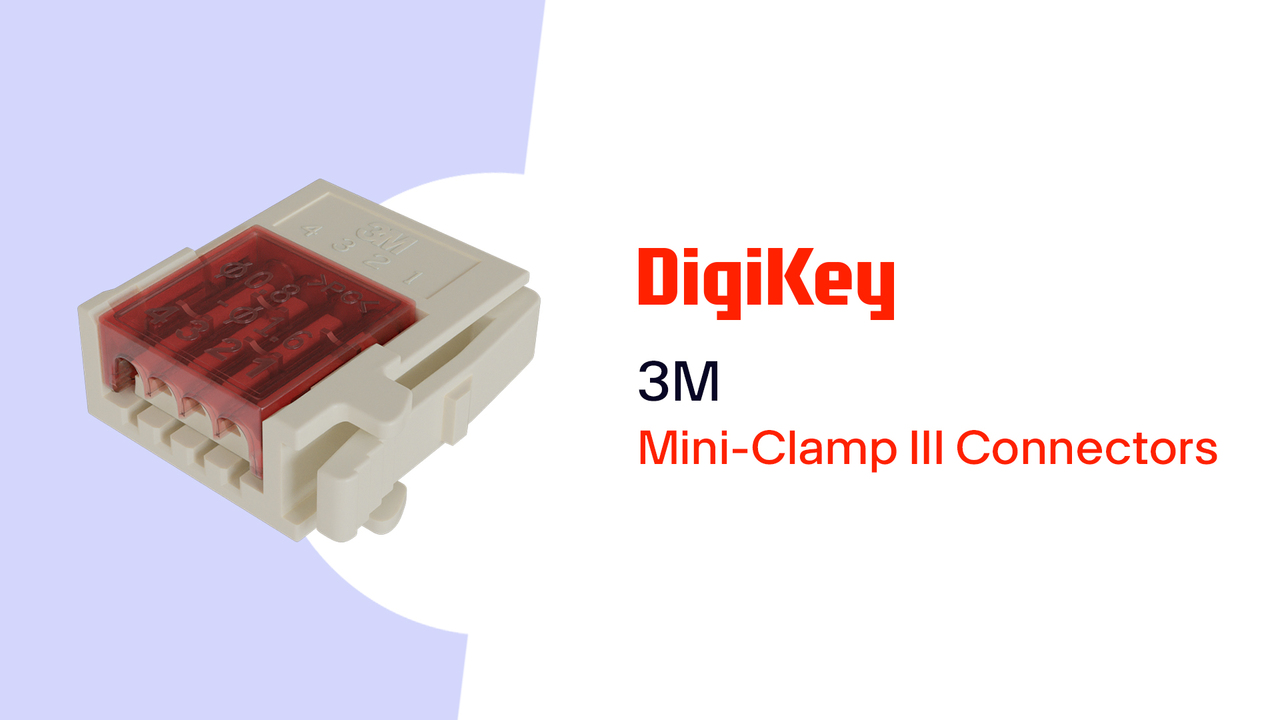
The 371 Mini-Clamp connector series (Figure 1) includes plugs and mating sockets for wire-to-board connections, and features three, four, six, or eight conductor positions and accommodates 28 to 20 AWG wires.
 Figure 1: The 3M 371 Series Mini-Clamp IDC connectors accept three to eight 28 to 20 AWG wires in a translucent housing that displaces the insulation when clamping pressure is applied. (Image source: 3M)
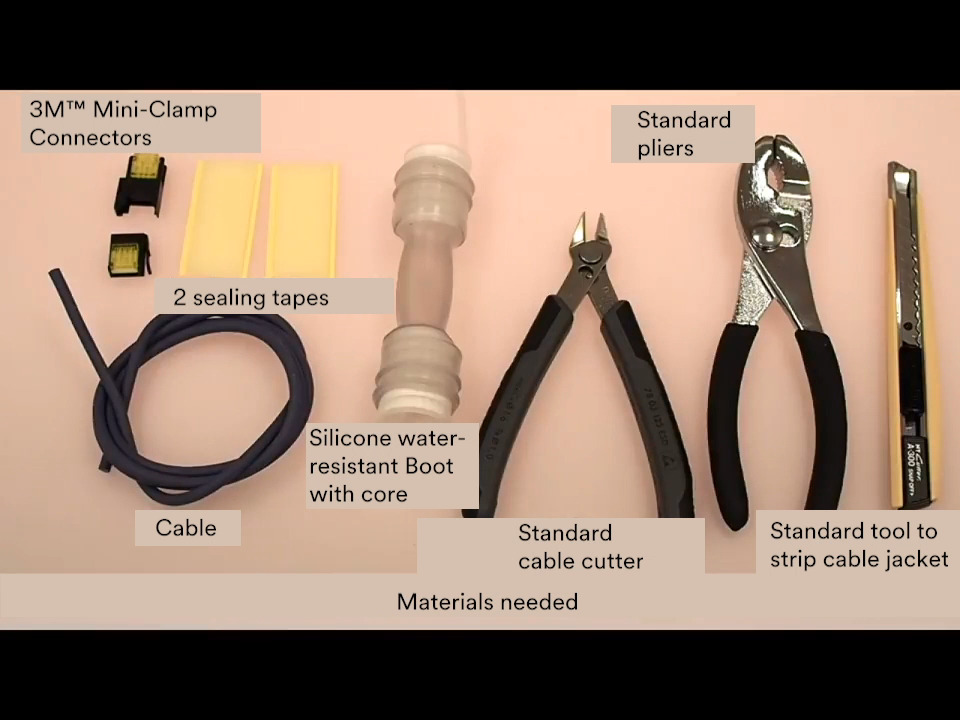
Installers insert insulated wires into the translucent part of the housing, which is color-coded by conductor size and allows visual confirmation that the wires are positioned correctly. When the installer applies pressure with a standard set of pliers, the translucent section is pushed into the housing, and the conductors are exposed without creating any debris.
Matching Mini-Clamp sockets in the 372 Series (Figure 2) can hold up to four plugs for as many as 16 conductor connections. Connectors in the Mini-Clamp product line are UL and cUL rated for 3.0 A and 32 V at temperatures between -20°C and +60°C. They have more than 1 x 10⁶ Ω of insulation resistance and 1,000 VRMS withstanding voltage at sea level. Mini-Clamp sockets have straight solder leads for connections to PCBs, and their 2.0 mm pitch allows for space efficiency and a greater concentration of conductors.
 Figure 2: The 3M Mini-Clamp IDC sockets secure one to four matching Mini-Clamp plugs to a PCB using a space-efficient design with a 2.0 mm pitch. (Image source: 3M)
Space savings are also behind the design of Mini-Stack connectors (Figure 3), which take up 30% less space than the Mini-Clamp line and still cut wiring time by about 60% compared to wire crimping.
 Figure 3: Mini-Stack IDC plugs use a double-IDC connection for greater reliability, stacking into blocks of four that mate with surface-mount sockets. (Source: 3M)
Like the Mini-Clamp connectors, Mini-Stack connectors use IDC technology that connects three to four conductors in a single step. The Mini-Stack line uses a double-IDC connection design to increase reliability while reducing part count and the risk of conductor damage. Built-in alignment bumps permit the plugs to be stacked into blocks of four, which then fit neatly into a surface-mounted socket on a PCB.
Mini-Stack connectors work with 30 AWG to 22 AWG wires and applications using up to 32 V and 2.0 A. They are UL94-rated for flammability and withstand temperatures from -20°C to +85°C.
In-line integration
Versatile Mini-Clamp connectors in the 371 series can make branching and wire-to-wire connections in addition to pairing with the PCB-mounted sockets mentioned above. Additionally, numerous two- and four-position link connectors from 3M that use IDC technology are available. (Figure 4).
 Figure 4: Two- and four-position link connectors from 3M use IDC technology, and hermaphroditic design streamlines installation and reduces part count. (Image source: 3M)
Mini-Clamp 38A connectors like the 38A04-0020-100 FL allow installers to easily add sensors and other components to a trunk line with a compact connector rated for 32 V and 3.0 A at -20°C to +60°C. As assembled, the connectors are 17.3 mm wide by 11.5 mm tall by 23.9 mm long, with length increasing to 29.2 mm when joined with the mating Mini-Clamp 371 plug. This two-piece design allows for secure attachment and easy detachment of branching wires to a trunk line with round conductors of 20 to 18 AWG or flat cables of 20 to 16 AWG with a 2.54 mm pitch.
Installation is completed by locking the conductors into the cover and temporarily attaching the center body. When pressure is applied with a set of pliers, the conductor insulation parts form the branching connection. Mating Mini-Clamp 371 plugs accommodate conductors as small as 30 AWG.
Mini-Clamp Series 387 connectors use a non-detachable single-piece design to reduce part count. The ultra-compact connectors are 18.4 mm wide by 16.0 mm long by 14.1 mm tall when assembled (Figure 5).
 Figure 5: Mini-Clamp 387 connectors feature a one-piece, non-detachable design for ultra-compact installation. (Image source: 3M)
Mini-Clamp 387 connectors are compatible with 2.54 mm pitch flat cable and 22 AWG to 16 AWG 16-round conductors. They are rated for signals up to 32 V and 7.0 A at temperatures from -20°C to +75°C. A splash-proof version of the connector that meets IP54 features the same electrical properties in a 14.0 mm long design.
Powering up field installations
Installers need only a set of pliers to create a T-Tap termination or a relay connection in power cables carrying up to 5.0 A over 22 to 18 AWG conductors using link connectors like those in the 381 Power Clamp series. The hermaphroditic IDC connectors can mate to themselves, reducing part count and adding design flexibility.
Other Power Clamp connectors, like the 355, 356, 357, and 358 series (Figure 6), also use IDC technology to ensure a safe and reliable electrical connection without the need for specialized tools, pre-connection conductor preparation, or extended downtime.
 Figure 6: Power Clamp connectors are color-coded and polarized for foolproof installation in T-Tap terminations and relay configurations. (Image source: 3M)
Power Clamp connectors’ translucent color-coded hoods allow installers to match the proper connector to the application’s wire size and to visually confirm placement. Polarizing tabs ensure that matched pairs of wires are properly connected.
Mechanical mating of the terminating or relay connector with the branching plug secures the connection in challenging industrial environments. The connector can be mated or unmated with one hand, further simplifying field installation.
Conclusion
IDC connectors like those in 3M’s Mini-Clamp, Mini-Stack, Power Clamp, and link connector portfolios reduce the time, material, and risk of deploying and expanding networks of conductors. By removing the need to strip or prepare conductors, IDC technology reduces installation time by half or more while also reducing waste from wire stripping and rework.

Haftungsausschluss: Die Meinungen, Überzeugungen und Standpunkte der verschiedenen Autoren und/oder Forumsteilnehmer dieser Website spiegeln nicht notwendigerweise die Meinungen, Überzeugungen und Standpunkte der DigiKey oder offiziellen Politik der DigiKey wider.