






 Settings
 Fast Delivery
 Free Shipping
 Incoterms
 Payment Types


 Marketplace Product

GPS Integration Delivers Novel Functionality and PCB Layout Challenges
Contributed By Electronic Products
2011-06-08
As familiar as GPS is to the general public, it is still a technology waiting to be discovered by many design engineers. Its synergy with other technologies, such as the Web, are only now being explored and its relative ease of integration into existing systems makes adding the additional functionality cost-effective.
The smart grid, for example, can use the exceptionally accurate time-stamping of GPS to calculate phasors on power distribution lines and allow corrections that enable the line to carry more power. In automotive applications, experimental systems use GPS to drive autonomous vehicles. Sophisticated toll-collection systems will eventually use GPS to allow charging for actual miles travelled.
One example of adding capabilities to complement basic GPS functionality is Honeywell Microelectronics’ Dead Reckoning Module. The 21DRM 4000 unit can be directly interfaced to GPS receivers. When GPS is not available, dead reckoning takes over by using a combination of technologies that include motion classification algorithms, which analyze walking motion and compensate when the user is running, and an automatic compass orientation algorithm. Other technologies utilized include gyros to compensate for transient accelerations that might affect compass operation and a barometric altimeter that fixes vertical position with 1.5-m accuracy.
For system designers, basic GPS capability is almost always integrated using a module that may or may not include an antenna and supporting chips, such as GaAs amplifiers. In simplistic terms, to enable a complete GPS receiver system, all a system engineer needs to do is connect the module to an antenna (either active or passive), provide a power source, and then connect the module to the host system.
However, while modules make GPS integration possible without an enormous design effort, RF issues associated with the signal path from the antenna to the module can have a big impact on system performance – even making the system nonfunctional.
Antenna selection is a primary consideration. Generally speaking, if less than 6 inches separate the antenna from the module; system designers should choose a passive antenna. Otherwise, an active antenna will compensate for cable losses and optimize the signal-to-noise ratio. Once an antenna has been selected, connecting it to the RF-input of the module is the single most important aspect of the design. A perfectly matched 50-Ω transmission line ensures maximum power transfer to the RF front end. Unmatched impedances in the signal trace, poor layout design, or energy coupling caused by poor grounding can all degrade performance significantly.
A 50-Ω grounded coplanar waveguide is usually the best option because it has lower transmission losses than microstrip or stripline connections. Coplanar waveguides have an RF ground on either side and an RF ground below, as shown in Figure 1. The RF grounds should be at least twice as wide as the signal trace width and the gap between the RF grounds and the RF signal is important.
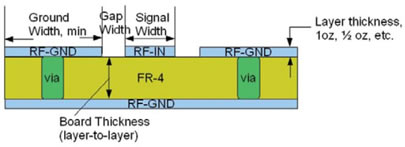 Cross section of a coplanar waveguide showing the positioning of the three ground traces and their widths relative to the signal trace. (Courtesy: DeLorme) |
A few helpful layout guidelines:
1. Be sure to partition digital and RF circuits in different regions of the board.
2. Keep RF signal paths as short as possible.
3. Avoid long digital signal paths – they tend to couple noise into the RF circuits.
4. Locate bypass capacitors as close as possible to the supply pin they are bypassing.
How to get it
A company which offers basic GPS modules is Telit Wireless. Although modules from all manufacturers have the same basic functionality, it is important to determine whether or not the antenna is integrated into the module, any additional memory requirements and price.
Telit Wireless’ smallest-form-factor GPS module, the Jupiter 3, has been designed to help developers reduce costs by accommodating system-level products with existing voltage regulation, real-time clock and supervisory circuit functions. The module also includes TCXO, LNA, and SAW filters to eliminate basic design tasks and enable faster time to market.
Additionally, Antenova offers a range of high-performance antennas and modules for GPS, mobile phones, portable devices and laptop computers. Its lightweight RadioNova coplanar SMD antenna is designed specifically for GPS signals and offers small footprint and easy integration onto PCBs. Antenova’s Brevis GPS antenna has roughly the same electrical characteristics but comes in a different size and shape. Both antennas are available in single-unit purchases as well as cut tape and Digi-Reel packaging.
Disclaimer: The opinions, beliefs, and viewpoints expressed by the various authors and/or forum participants on this website do not necessarily reflect the opinions, beliefs, and viewpoints of DigiKey or official policies of DigiKey.









 Austria