Settings
 Fast Delivery
 Free Shipping
 Incoterms
 Payment Types


 Marketplace Product

Engineering IAQ Monitoring for Modern Buildings with Integrated Advanced Sensors
Contributed By DigiKey's North American Editors
2026-01-20
Between the home, office, and school, people spend a lot of time indoors. According to the U.S. Environmental Protection Agency (EPA), Americans spend approximately 90% of their time indoors, where the concentration of pollutants is two to five times higher than outside. Per the EPA, most of the pollutants affecting indoor air quality (IAQ) come from sources inside those buildings, although some can also originate from outdoors.
Because air quality is directly connected with human health and well-being, IAQ monitoring has become increasingly important and commonplace. Regulatory requirements are further driving interest in these solutions, enabled by advancements in air quality sensors.
Indoor and outdoor pollution sources
Typical sources contributing to indoor air pollution include tobacco smoke, fuel-burning appliances, wood- and coal-burning fireplaces, building materials and furnishings, as well as household products like cleaning agents, paints, and air fresheners. While smoke and fire can release carbon monoxide (CO), nitrogen oxides (NOx), and particulate matter (PM) directly into the indoor environment, household products can introduce many different chemicals directly into indoor air, including volatile organic compounds (VOCs).
Relative humidity (RH) and temperature are also considered important IAQ parameters because they impact a person’s comfort, health, and the levels of other pollutants in the air.
From the outdoors, air pollutants like smoke from chimneys can re-enter homes through windows, ventilation systems, and cracks in structures, while radon coming from building foundations can also enter through cracks or gaps. Volatile chemicals in water supplies may also pollute indoor air when building occupants use the water for showering, cooking, and cleaning. Furthermore, when people enter buildings, they inadvertently bring in soil and dust on their shoes and clothing, along with pollutants that adhere to those particles.
In addition, there are biological contaminants in indoor air such as viruses and bacteria, animal dander, house dust, mites, and pollen that are created by humans, animals, and plants.
Health hazards from air pollution
Good air quality is crucial for human health. Poor air quality can result in issues ranging from respiratory diseases to fatigue and allergies, including irritation to the eyes, nose, and throat. Other serious health problems associated with indoor air pollutants are heart disease and cancer.
The link between common indoor pollutants such as radon, CO, Legionella bacterium, and adverse health problems is well established. For example, radon, a known human carcinogen, is the leading cause of lung cancer in non-smokers. Short-term exposure to elevated levels of CO in indoor settings can also be lethal. Additionally, episodes of legionnaires’ disease, a form of pneumonia caused by exposure to Legionella bacterium, have been associated with buildings that have poorly maintained air conditioning or heating systems, hot tubs, and plumbing.
Healthy building standards and compliance
Several standards have been established over the years to guide the monitoring and maintenance of IAQ. These are important to adhere to as much as possible for both residential and commercial building owners to ensure the well-being of occupants.
Agencies that provide such guidelines include the U.S. EPA, the World Health Organization (WHO), the Occupational Safety and Health Administration (OSHA), the American Society of Heating, Refrigerating and Air-Conditioning (ASHRAE), and the WELL Building Institute. Well-known building standards that require systems to monitor and maintain good IAQ include California Title 24 (CA 24), developed by the California Energy Commission, and the Leadership in Energy and Environmental Design (LEED) rating system by the U.S. Global Building Council (USGBC). The RESET Air Standard, in particular, is a globally recognized benchmark for IAQ monitoring and certification, focusing on real-time data-driven measurement of important IAQ parameters.
All-in-one sensors that accurately monitor air pollution
For sensor makers like Sensirion, complying with relevant building standards is mandatory for meeting market expectations. As a result, they have designed and built products that are compatible with RESET, WELL, CA24, and LEED. Moreover, unlike traditional products that require multiple sensors for monitoring IAQ parameters, Sensirion has simplified the task by developing an integrated solution in a compact module that is easy to implement, the SEN6x sensor platform (Figure 1).
Utilizing integrated algorithms, it is capable of measuring up to nine environmental parameters, including PM1, PM2.5, PM4, PM10, RH, temperature, VOC index, NOx, carbon dioxide (CO2), and/or formaldehyde (HCHO).
 Figure 1: The all-in-one SEN6x sensor platform is capable of measuring up to nine environmental parameters. (Image source: Sensirion AG)
The key component of the SEN6x module is its miniaturized microelectromechanical systems (MEMS) PM sensing unit, known as the SPS6x. Its patented geometric arrangement, advanced MEMS, and packaging techniques allow for integrating the light source, detector, signal processing, and algorithm into a cost-effective and compact solution for measuring PM1, PM2.5, PM4, and PM10. The onboard algorithms analyze the scattered light to determine the particles’ size distribution and mass concentration. The innovative chip-scale PM sensing, combined with the patented sheath flow, enables SEN6x sensors to deliver unparalleled dust protection and longevity while consuming very low power.
The primary model available in this series is the SEN66, which can measure PM, RH, temperature, VOC, NOx, and CO2. To enable users to get a faster and more reliable temperature reading from the integrated sensor module, the SEN66 implements the proprietary Sensirion Temperature Acceleration Routine (STAR) engine. This engine dynamically estimates the temperature value before the end product reaches a thermally stable state.
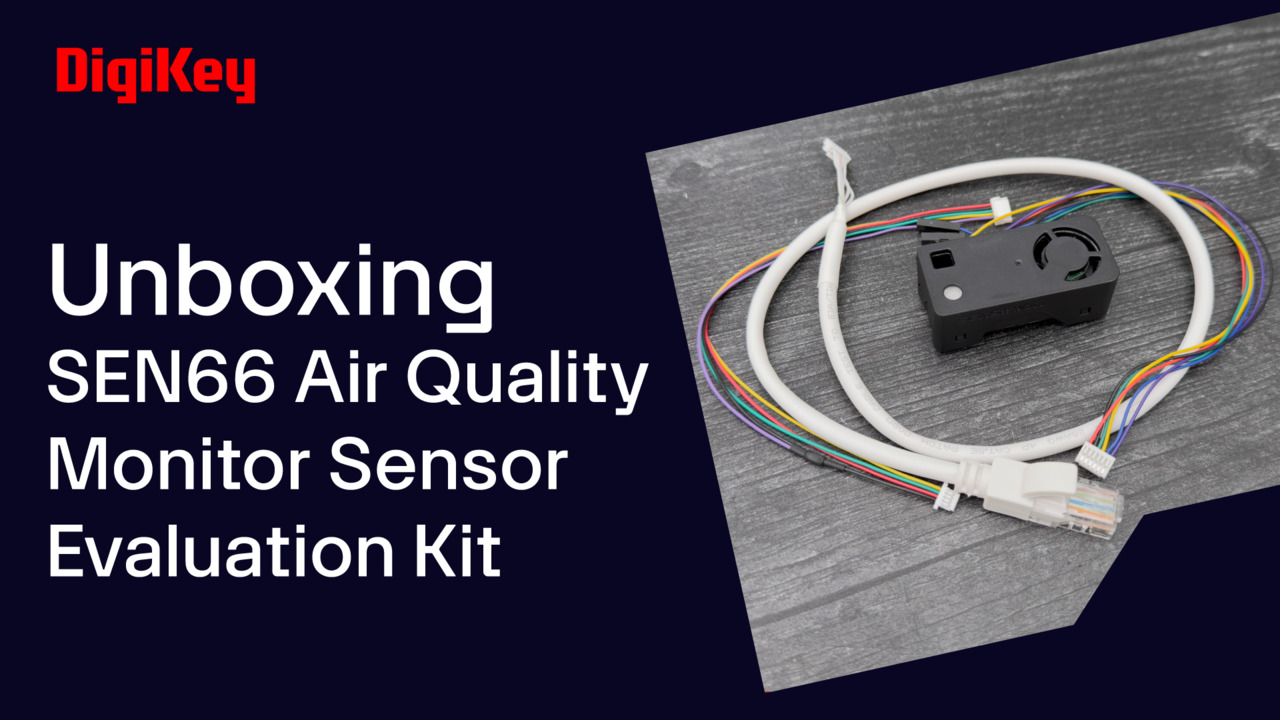
For application development, Sensirion offers the SEK-SEN66 evaluation kit (Figure 2). It comes with the SEN66 integrated sensor node for measuring multiple pollutants, an adapter cable, and a jumper wire set for prototyping.
 Figure 2: The SEK-SEN66 evaluation kit includes the integrated sensor module, an adapter cable. and a jumper wire set for connections and prototyping. (Image source: Sensirion AG)
In order to use Sensirion’s user-friendly software ControlCenter, the user must separately purchase the SEK-SensorBridge (Figure 3), which provides the interface between the sensor and a host computer.
 Figure 3: The SEK-SensorBridge is Sensirion’s universal interface tool for evaluating its sensors. (Image source: Sensirion AG)
The SEK-SensorBridge technical guide explains the physical connection of the sensor evaluation board to the SensorBridge using the adapter cable, and the connection to a PC via the USB cable.
Discrete IAQ sensors
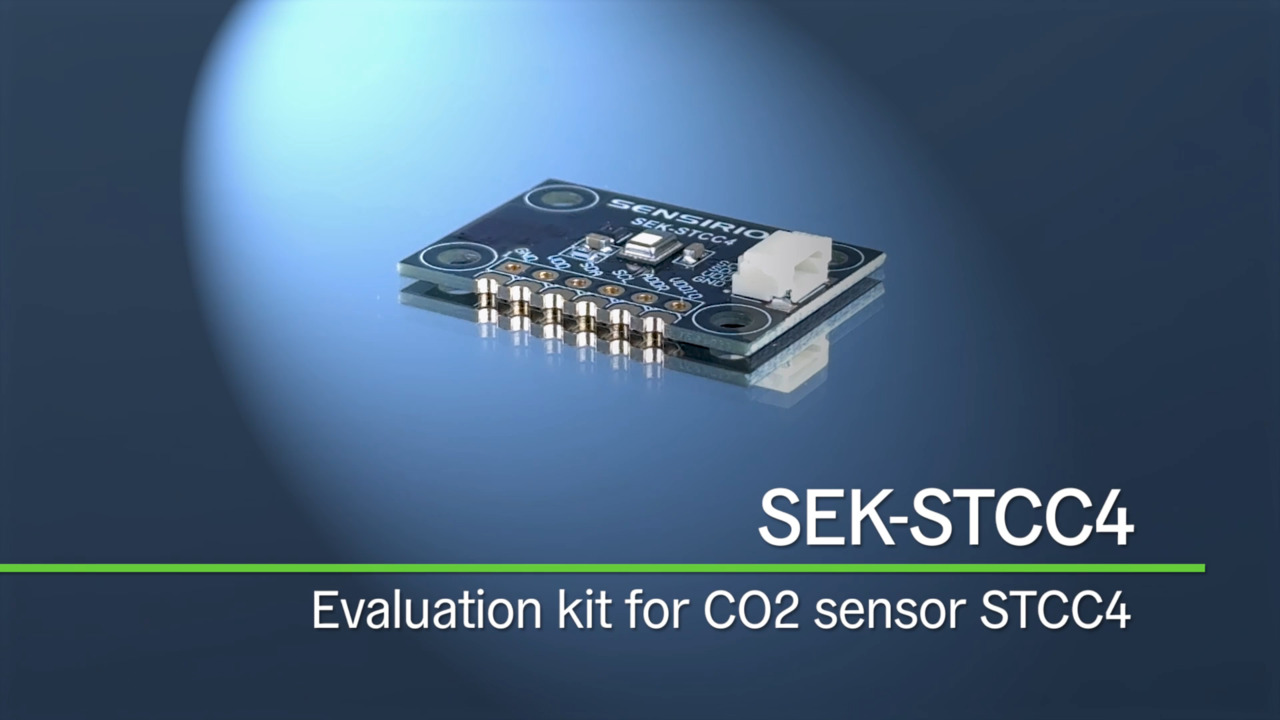
Sensirion also offers several discrete CO2, RH, and temperature sensors. For CO2 monitoring, there are two notable models available, the SCD43 and the STCC4 (Figure 4). While the SCD43 is a photoacoustic non-dispersive infrared (NDIR) CO2 sensor, the STCC4 implements thermal conductivity sensing techniques. Labeled as a next-generation CO2 sensor, the STCC4 has the supplier’s smallest footprint (4 mm x 3 mm x 1.2 mm) for integration into compact electronic devices.
 Figure 4: The STCC4 offers one of the smallest form factors for compact electronic devices. (Image source: Sensirion AG)
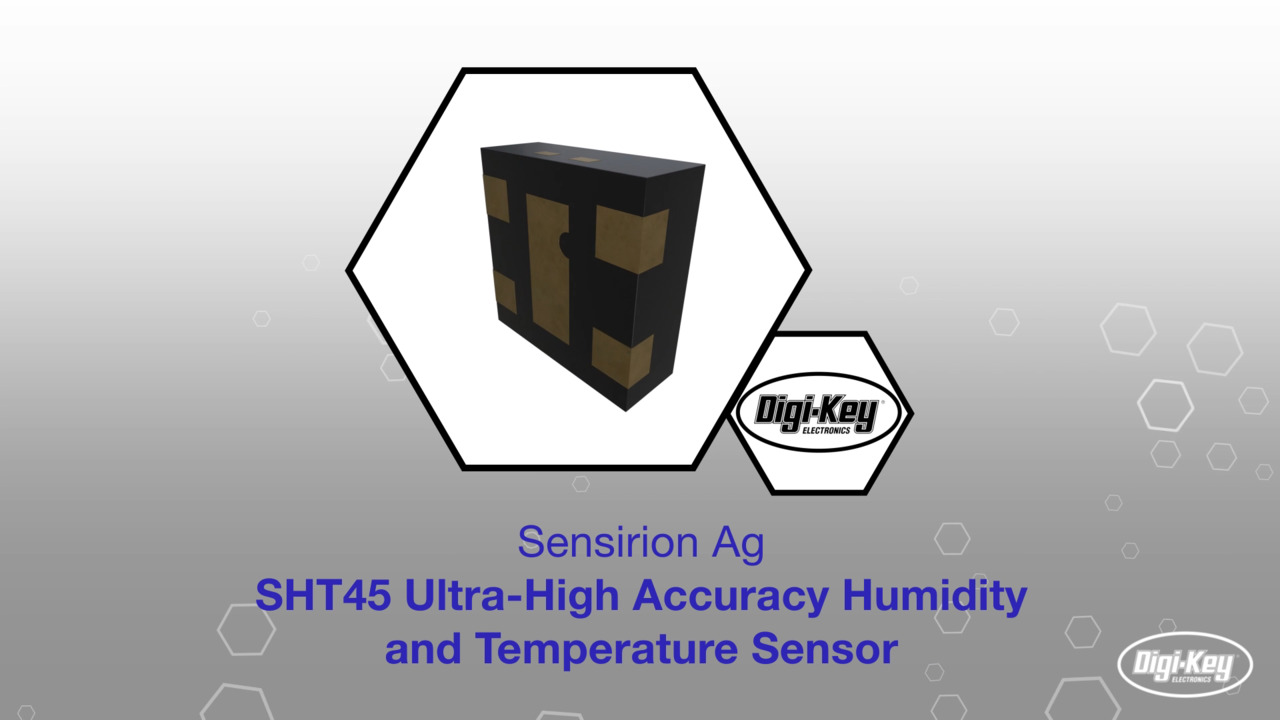
For applications focused on indoor RH and temperature parameters, the discrete SHT4x series offers high accuracy with reduced power consumption. Tailored for battery-operated mobile devices, they are also compliant with the RESET and WELL standards.
Conclusion
To simplify the evaluation and application of IAQ monitors, sensor expert Sensirion has developed all-in-one solutions that integrate multiple sensors with algorithms and software. These solutions enable accurate measurement of a wide range of air quality parameters using a single compact module. Besides cutting costs and reducing time to market, the integrated sensor modules also consume less energy. Simultaneously, Sensirion offers discrete sensors that are notable for their small size, high accuracy, long term stability, and ease of integration.

Disclaimer: The opinions, beliefs, and viewpoints expressed by the various authors and/or forum participants on this website do not necessarily reflect the opinions, beliefs, and viewpoints of DigiKey or official policies of DigiKey.