






 Settings
 Fast Delivery
 Free Shipping
 Incoterms
 Payment Types


 Marketplace Product

A Powerful Show: What APEC 2012 Offered the Design Engineer
Contributed By Electronic Products
2012-05-01
The 2012 Applied Power Electronics Conference (APEC) held in Disney’s Coronado Springs Resort in Orlando, Florida, was an outstanding event in terms of technical papers, presentations, and professional seminars. A record number of exhibitors showcased their newest and best products. Leading the pack were devices for handling high-current, dimming LEDs, improving efficiency, and lowering noise.
The most interesting, and possibly the most important, introduction in terms of future design efforts was the unveiling of new gallium nitride (GaN) and silicon carbide (SiC) products. APEC validated that these new technologies are now viable products that can compete with silicon on a cost and technology basis. Additionally, it’s not an either/or scenario where you have to choose GaN or SiC. Yes, there are many improvements that remain to be made for both technologies, but several manufacturers at APEC, including Texas Instruments, International Rectifier, Cree, SemiSouth, Renesas, and Power Integrations, believe the time is now for customers to start using either or both of the two technologies in their power-critical designs. For example, International Rectifier (depletion mode GaN HEMT FET) and Efficient Power Conversion (EPC - enhancement mode GaN transistor) attended the convention with their latest products and were enjoying the success of having other proponents such as TI open up new doors for customers wanting to design with GaN.
For example, TI added a second eGaN FET driver, the LM5114, to its award-winning arsenal (first was the LM5113). A low-side gate driver for use with MOSFETs and GaN power FETs in high-density power converters, it provides isolated DC/DC conversion for high-performance telecom, networking, and data center applications.
EPC was there touting a hot-off-the-press book “GaN Transistors for Efficient Power Conversion” (ISBN 978-0-615-56925-3) that provides the reader with an overview of GaN and then describes eGaN FET electrical characteristics, driver and layout considerations, followed by chapters on buck converters, isolated full-bridge converters, and flyback converters. It even includes some rules of thumb for the GaN devices, detailed instructions for LTSPICE models, and a discussion on when eGaN FETs will replace power MOSFETs.
SiC products were talked about by several companies including Cree, Renesas, SemiSouth, and Power Integrations. SiC is important because it exhibits a critical breakdown field approximately 10 times that of silicon. It enables the development of a thinner device structure for a breakdown voltage and reduces the on-resistance of the device by about two orders of magnitude compared to a silicon device. There are several other significant differences between SiC and Si, such as higher thermal conductivity, current density, and lower leakage. The downside of SiC vs. Si is the higher device cost, which could prevent the engineer from obtaining authorization to purchase it from the company’s budget-masters. That is changing, slowly, as companies realize that although the cost for SiC MOSFETs is more than Si MOSFETs and IGBTs, its overall system impact provides a real cost savings, as well as an energy savings from higher efficiency, which is a big deal in products like solar inverters.
Another change at APEC from previous years was the realization by the SiC and GaN manufacturers that there is room for both technologies to provide solutions for power designs, with GaN targeting applications below 600 V (really only 200 V right now) and SiC targeting applications above 600 V. This is good news for design engineers trying to decide which technology to use for their cutting-edge designs.
LED drivers
Even though it is an area exploding with development, there are still challenges to implementing LED bulb designs. For example, the LED bulb must meet the Energy Star standard for 80 percent efficiency, meet the EN61000 power factor correction requirements of >= 0.7 (residential) and >=0.9 (commercial), and they must have flicker-free dimming operation. To meet these needs, Fairchild Semiconductor introduced the FL7730, a single-stage dimmable primary-side regulation LED driver that also provides ±5 percent current control. It supports Triac and analog dimming with flicker-free dimming over the entire dimming range. An application board diagram of the FL7730 Triac dimming circuit is shown in Figure 1.
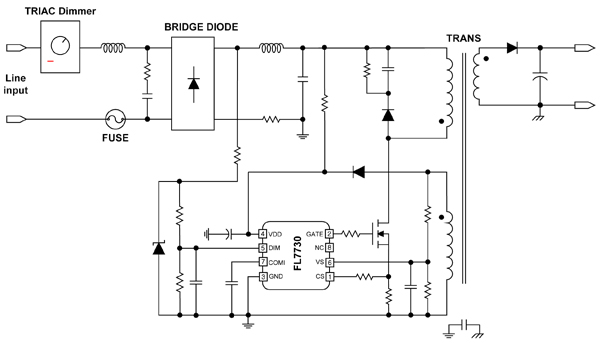
Figure 1: Application board diagram for a Triac-dimming design.
Power handling
The task of handling current and power for CPUs is putting pressure on manufacturers as size requirements are shrinking and the peak current carrying capacity is increasing along with demand for higher efficiency. To help designers meet these opposing requirements, International Rectifier has added the IR3551 to its PowIRstage line of buck gate drivers. The device handles up to 50 A, has 94.5 percent efficiency at 1.2 V output and targets high-end processors and DDR memory current-carrying requirements. It integrates a synchronous buck gate driver, synchronous MOSFETs and a Schottky diode into a small, high-density, low-profile 6 x 5 mm footprint. What makes these devices so impressive is their ability to carry such high currents at low temperatures. For example, the IR3550 can handle 60 A continuously at about 90oC with air cooling, compared to the best competitive products that can only handle mid-40oC and run hotter at about 125oC. What it means for the designer is a smaller solution size with the needed efficiency and peak current demands.
IR also introduced a digital controller, made possible by its March 2011 acquisition of CHiL Semiconductor. This purchase was a logical move that led to the introduction of the IR35xx family of digital PWM controllers that help the company meet Intel’s VR12/12.5 and AMD’s SV11/12 specifications and support one to eight phases operating one to two loops. It uses CHiL’s adaptive transient algorithm that enables transients to be handled with fewer phases and capacitors, thus shrinking the system size.
Texas Instruments introduced the UCD3138, a digital controller for isolated power that targets AC/DC and DC/DC power supplies. It allows the design engineer to reuse hardware across multiple designs using a combined 32-bit microprocessor, data converter, and programmable state machine for loop control, as well as providing analog peripherals and communication capabilities. It supports power supplies used in servers, telecom rectifiers, and DC/DC modules. And if you need help, TI provides development tools, evaluation modules, development kits, reference designs, application firmware source code, and software development tools using a graphical user interface.
The APEC show continues to be the industry’s premier power electronics show because attendees know that it is the event where manufacturers and engineers get together to help each other develop solutions. It also adds to the engineer’s design arsenal by providing the training needed to keep up with leading-edge technologies.
Reference:
Disclaimer: The opinions, beliefs, and viewpoints expressed by the various authors and/or forum participants on this website do not necessarily reflect the opinions, beliefs, and viewpoints of DigiKey or official policies of DigiKey.









 Austria